
THIS IS CURRENTLY A WORK IN PROGRESS. (with help from The Vikings!)
Introduction
This document is to provide a guide for new members to getting their first set of kit sorted. Here we will cover several items in order. Firstly we will cover what you need to get for a first set of kit, male, female and combatant along with this there should be information on what material it should be made out of and what colours. Secondly there will be a section on how to construct kit.
But to start we will have a few basic rules. These items are not to look for.
- a) Roman, Post-Roman or later Medieval helms
- b) Plate Armour of any sort.
- c) Live-role-play type weapons.
- d) Knitted ‘String’ mail.
- e) Non-authentic footwear.
- f) Tartan of any description.
- g) Shields that are not round or kite shaped, or any made of Hardboard, Chipboard or MDF.
- i) Furry jackets or waistcoats.
- j) Body Armour made of Horn, Bone, Wood, Leather or any form of sheet metal.
- k) All visible body piercings and make-up should be removed and all tattoos should be covered by costume or masking make-up.
Other things to look out for:
One of the primary considerations you should have is consistency. Consistency in Culture, time and class. You should try not to “mix and match” the items you like. Arguments such as “I found it” or “I bought it from a trader” or “it was passed down through my family” should be avoided. A good example is swords. Swords are a weapon that was limited to the wealthy warrior class. Certainly as the period we portray progresses they become more common, however if you carry a sword you must wear appropriate status soft kit. This is why this kit guide doesn’t cover Swords, as a new member you shouldn’t be purchasing a sword straight away.
The internet can be a great place to acquire kit quickly. However, it can also be a great way to spend a lot of money on kit which turns out not to be right for the period. The best thing to do is to ask other members of the group for advice. This is especially true of eBay – items tagged as ‘re-enactment’ or ‘viking’ are not always suitable for either. Be wary as well at large re-enactment trading events. With multiple stalls covering multiple periods it is very easy to accidentally buy something inappropriate. Be sure to talk to the traders, they are often extremely knowledgeable about what they are selling, especially if they are a specialist trader. If you are not sure, seek the advice of the authenticity team.
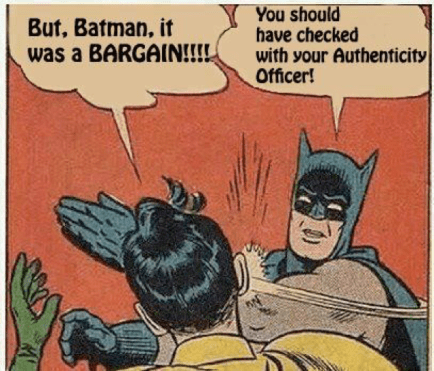 Figure 1 – DO NOT DO THIS
Living history
You’ll likely want to spend time in our LH camp, therefore it is important to at least look into getting a wooden bowl, cutlery (a knife and spoon) and a cup or drinking horn. They can be transported in a small linen bag with your car keys, wallet and phone.
Be warned – charity shops frequently stock nice wooden bowls and plates quite cheaply… but they’re not necessarily suitable for our use. They are frequently made from tropical hardwood (usually looks very dark) which is not authentic and is quite easy to spot. Similarly, wooden bowls made in pieces and glued together should be avoided. By all means use them for banquets, but not in the LH camp, if in doubt ask the LH officer or the authenticity team.
Kit List
Male
Required (For very low status look for a *)
Tunic* – made of wool* or linen (wool is preferable)
Trousers – made of wool or linen (wool is preferable)
Winnegas* – made of wool
Shoes – leather
Cloak – wool
Belt – Leather, lucet braid, table weave or rope*
Suggested
Under tunic – linen
Hat – wool
Cloak pin – metal
Pendant – metal/wood/bone
Optional
Socks – wool
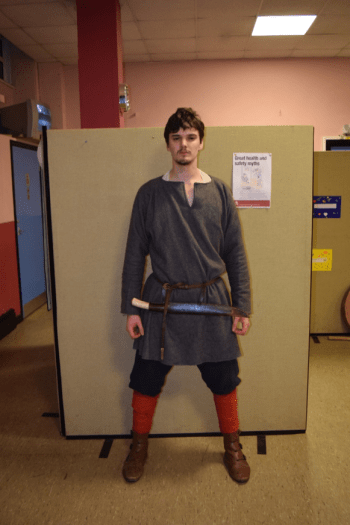
Figure 2 – A good set of basic starter kit.
Figure 1 shows a good set of starter kit, this member has all the basic items including a tunic and under-tunic, trousers, winnegas, shoes and a leather belt. He also has a leather sheathed seax, this would be a common sight for any free man in the dark ages as carrying a weapon was a sign of being free.
This kit is acceptable for mid status. He is aspiring to higher status, hence his brightly coloured winnegas, it is thought that (similar to today with knock off brands) he might be trying to appear higher status the cheapest way possible.
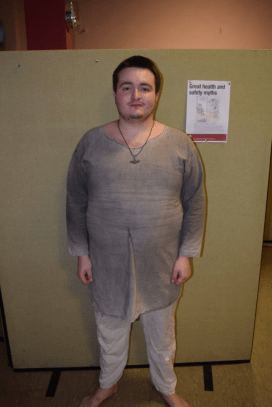
Figure 3 – An example of very low status kit.
This member is showing an example of low status kit. He is wearing un dyed linen, and is only wearing a pewter Mjolnir. He is not carrying a weapon and is therefore unlikely to be free. His clothes would be supplied by his master.
Female
Required (for very low status see*)
Over Dress* – Wool* or linen
Shoes – Leather
Head covering – SAXON linen
Cloak – wool
Suggested
Belt – Tablet weave, lucet
Under dress – Linen
Trousers – Linen or wool
Cloak pin – metal
Pendant – Pewter, Bronze or silver
Optional
Utility knife
Socks – wool
Glass beads (High status Viking)
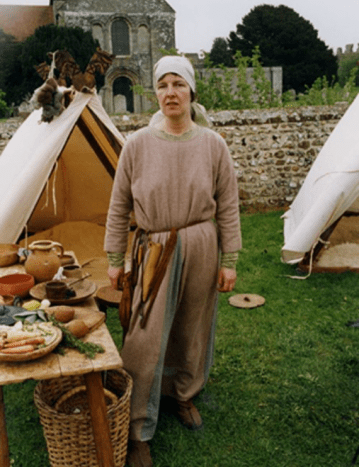
Figure 4 – Dark age female dress
This person is wearing a low to mid status female dress, she has shoes and a woollen over dress, she is wearing a linen head covering. She has a fabric belt and hanging from it are several domestic utility items, knives and a pouch. These things add depth to any character.
Combat kit
Required
Helmet – 16 Guage steel minimum, nasel or spectacle helm (only for Vikings). Can be spun skull cap but must be disguised as a hat.
Gloves – Padded authentic looking gloves.
Spear – between 5ft6 and 7ft6.
Recommended
Shield – Planked or plywood recommended
Axe – Of authentic design
Seax – With a sheath
Optional
Modern protective armour – Elbow, shin, knee etc.
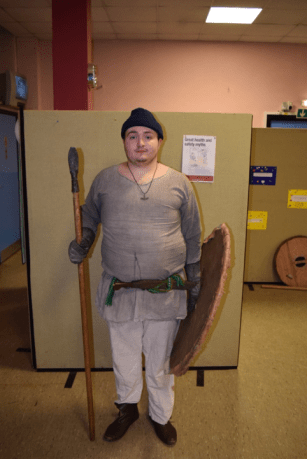
Figure 5 – Low status combat kit.
This member has low status soft kit accompanied by a seax, shield and a spear. His helmet is a steel skull cap covered by an authentic hat.

Figure 6 – Mid status combat kit
This member has mid status combat kit, he has an axe, seax and a shield , he has a nasal helmet. He would likely also have a spear.
IMPORTANT NOTE:
Females are welcome to take the field of battle, however they MUST have a male persona and dress as a male.
Construction of kit
The construction of kit is relatively simple, below I will post some pictures of tunic and trouser patterns. You simply take your measurements and apply them to these patterns. It is much easier to learn how to do it practically by speaking to current members. You should endeavour to turn up to a Monday Thing when you can ask one of the authenticity team or the LH officer or any other member to help you with measurements.
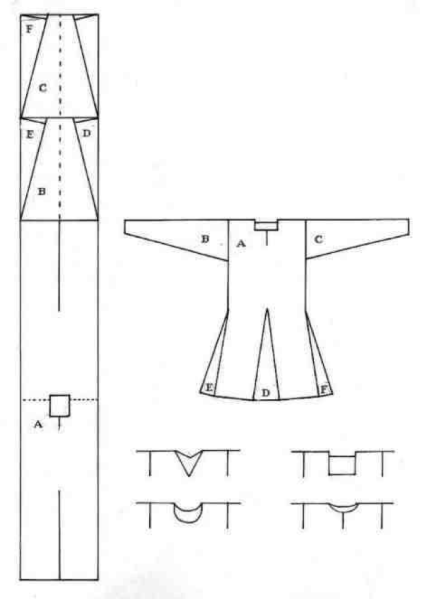
Figure 7 – Generic tunic
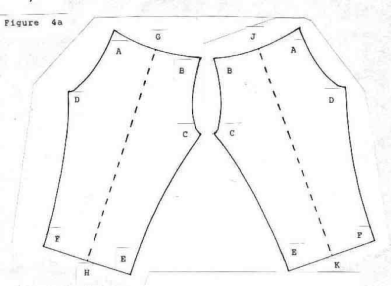
Figure 8 – Generic trousers
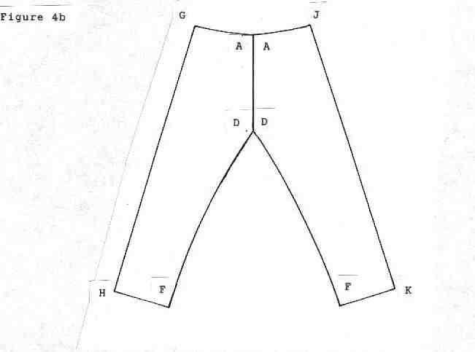
Figure 9 – Generic trousers
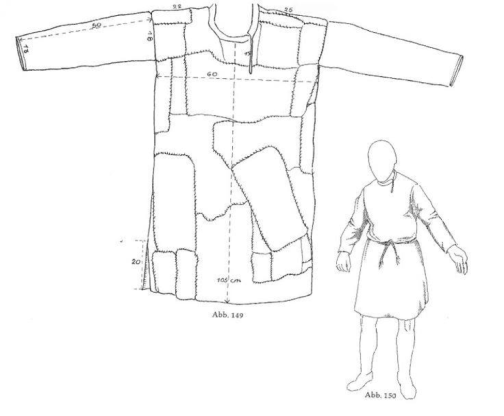
Figure 10 – Bernuthsfeld tunic/shirt
 Bersi.co.uk